
- Acumatica rates well overall, so leave for specific reasons such as transaction-tier pricing, license changes, upgrades that break customizations or a weak reseller.
- Customers report price-list imports and EDI updates counting toward transaction tiers, and one distributor was asked for about 20% more.
- The Classic UI is deprecated in 2026 R2, and SaaS customers on retired versions report a 25% premium.
- Stay when your volume sits inside your tier, your processes fit the standard product and your reseller answers quickly.
- Plan an exit around the renewal date, run both systems side by side through a month-end close, and move data in a set order.
- A custom cloud system removes the reseller and the transaction tier, but adds build, hosting and maintenance costs and needs an owner inside the company.
Is it time to leave Acumatica in 2026? Resource pricing, the Vista sale and your options
/ 10 min read

TL;DR
Leave Acumatica when its pricing model or its upgrade cycle now costs you more than the product returns. The clearest signs are routine imports pushing you into a higher transaction tier, license terms changing mid-relationship, upgrades that break customizations and a reseller you cannot rely on. Stay if your volume sits well inside your tier, your processes fit the standard product and your reseller is strong, because Acumatica rates 4.4 on G2 and Capterra and its usage-based pricing suits companies with many users. If you leave, the usual destinations are NetSuite, Business Central, Odoo or a custom cloud system you own. Plan the exit around your renewal date, run both systems side by side and move the data in a set order.
Key takeaways
On this page
Who should leave Acumatica, and who should stay
Acumatica is one of the better rated cloud ERPs. It scores 4.4 on G2 and Capterra, and it draws fewer public complaints than NetSuite, Odoo or Salesforce. Most companies on it should not leave because of one bad quarter.
Leaving makes sense for a mid-size company when three things are true. Your transaction volume or license terms are pushing the bill up faster than the business is growing. Your customizations break at each release and cost reseller time to restore. And your reseller cannot fix either problem.
Staying makes sense when your volume sits comfortably inside your tier, your processes match the standard product and your reseller answers quickly. In that case a move is likely to cost more than it saves.
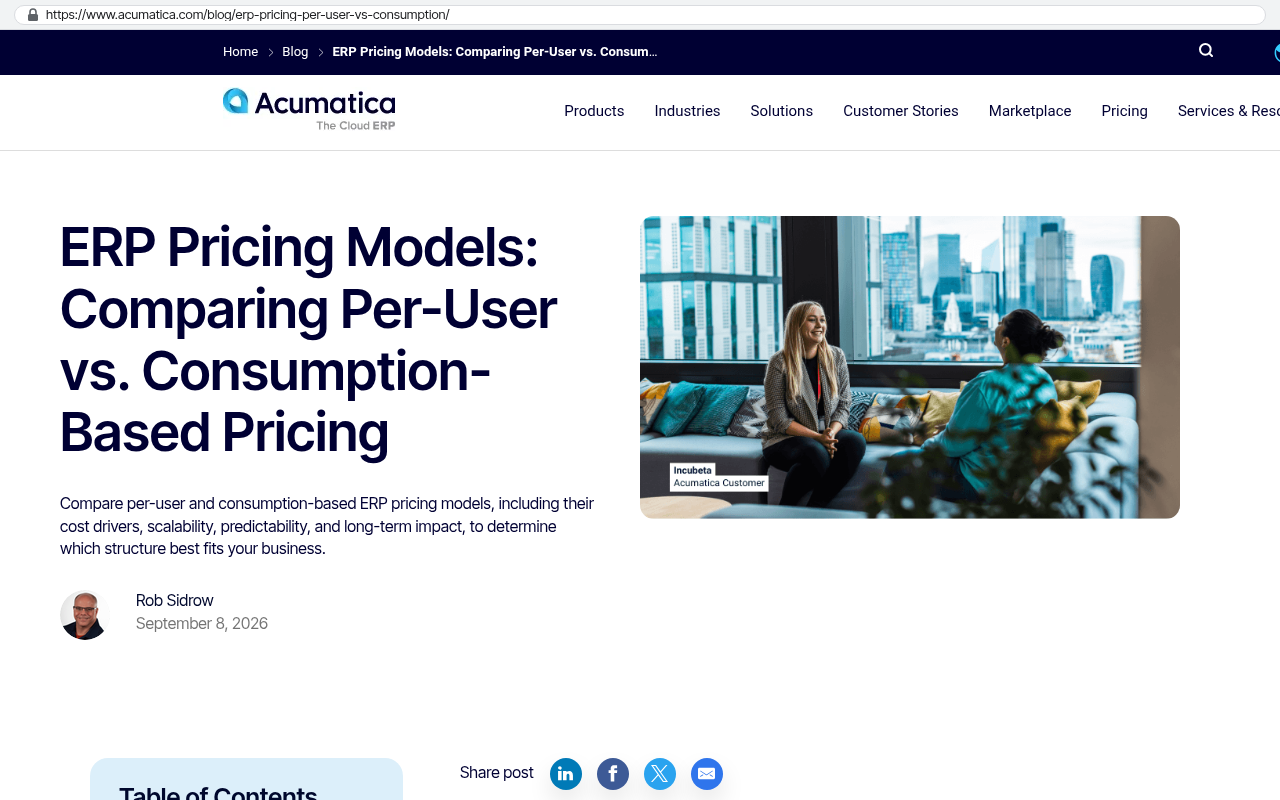
The next renewal decides it. Acumatica caps renewal increases at 10%, but customers report that the cap ignores first-term discounts and lapses if you cut users, edition or tier (Stacksync, AuditFriendly). Price your next term under the terms you will have, then compare it with the cost of leaving.
Signs it is time to leave Acumatica
Each sign below comes from customer reports on Acumatica's own community forum, review sites and pricing analysts. One sign on its own is rarely enough. Three or four together, getting worse at each renewal, is the pattern to watch.
- Routine imports push you into a higher pricing tier. Acumatica prices by monthly transaction volume, and customers report that price-list imports and EDI updates count. A distributor with 200,000 items reported about 300,000 transactions a month from price updates alone, had spent over $500,000, and was asked for about 20% more. Another customer limits its own imports to stay under its tier. Threads run from May 2025 to August 2026 with no official fix (Acumatica community).
- License terms change during the relationship. A five-year customer reports being told in March 2026 that adding AI Studio meant a new license model at about 55% more, with users capped at 50. Customers also report a five-tenant cap per subscription from early 2025 (Acumatica community).
- Upgrades break what you paid to build. Customers report that major upgrades unpublish customizations until a reseller republishes them, and a February 2026 thread reports working features failing after upgrades (Acumatica community). Acumatica releases twice a year, so the cost repeats.
- Falling behind costs 25% more. SaaS customers on a retired version report a 25% Retired Version Premium that users say was not announced. Forum and reseller sources describe it, and no official Acumatica page for it was found (Acumatica community).
- The new interface is slower, and you have to move to it. Acumatica deprecates the Classic UI in 2026 R2, and Classic-only screens go away in 2027 R1 (deprecation notice). Customers report timeouts and lag in the Modern UI, and support told at least one customer to go back to Classic while R&D investigates (Acumatica community).
- Performance drops as your data grows. Customers report slow saves, slow large reports, dashboards that degrade and 15 to 30 second screen loads for one administrator (Acumatica community).
- Your reseller is the weak link. Acumatica sells only through resellers. Customers report a reseller with no finance knowledge that refused accountability, another that was sold on the customer's go-live day, and a third customer passed from Acumatica to yet another reseller (TrustRadius, Capterra).
- Support is slow and Acumatica is hard to reach. Critical Gartner reviews from August 2025 cite slow resolution of complex issues, and SelectHub puts about 70% of support mentions as negative (Gartner, SelectHub).
- Reporting pushes finance into other tools. Customers report Report Designer queries that validate and then fail at runtime, no preview against live records, limited formatting, and financials run in outside tools (Acumatica community).
- Integrations and connectors break. API users, concurrent requests and requests per minute all scale with license tier, and overflow is throttled or rejected (Acumatica documentation). Shopify connector threads from 2022 to September 2026 report wrong inventory, aborted orders and permissions broken after the 25R1 upgrade (Acumatica community).
- Missing features turn into paid add-ons and custom work. G2's review summary lists missing features in 229 mentions and a steep learning curve in 181, and customers report that resellers charge for every update.
- Specialists are hard to hire. Customization is written in C# on Acumatica's own framework, so the hiring pool is narrow, according to a staffing firm (Kore1).
- Industry editions do not fit your work. Recent reviews say the Construction Edition does not suit general contractor accounting and that field service lacks equipment history (Trustpilot).
Acumatica also agreed in May 2025 to be acquired by Vista Equity (BusinessWire). No customer evidence yet ties the new owner to price rises, so treat the sale as context and not as a sign. For the general case beyond Acumatica, see signs it is time to replace your ERP instead of upgrading it.
When staying on Acumatica is the right call
Staying is the better choice for many Acumatica customers, and the reasons are specific.
- You have many occasional users. Acumatica prices by applications and usage, not by user seats, so adding warehouse staff or approvers does not add a seat fee the way a per-user license such as NetSuite or Business Central does.
- Your transaction volume sits well inside your tier, and price imports and EDI do not push you toward the next one.
- Your processes fit the standard product, so you carry few customizations for a release to break.
- Your reseller is strong. It answers quickly, knows your industry and has taken you through upgrades without lost work.
- You went live recently. Switching now writes off the implementation spend, and resellers estimate mid-market Acumatica implementations at $40,000 to $150,000 (CostBench, a vendor-side estimate).
- Your problem is one report or one integration. Fixing that piece costs less than a new ERP. See how to connect the tools you already use instead of replacing everything at once.
Use the renewal to negotiate before you decide to leave. Ask for the renewal cap in writing, confirm how it applies after first-term discounts, and ask what triggers the next transaction tier. A clear answer on those three points can settle the decision. For the wider version of this question, read when staying on your current platform is the right call.
Where companies go from Acumatica
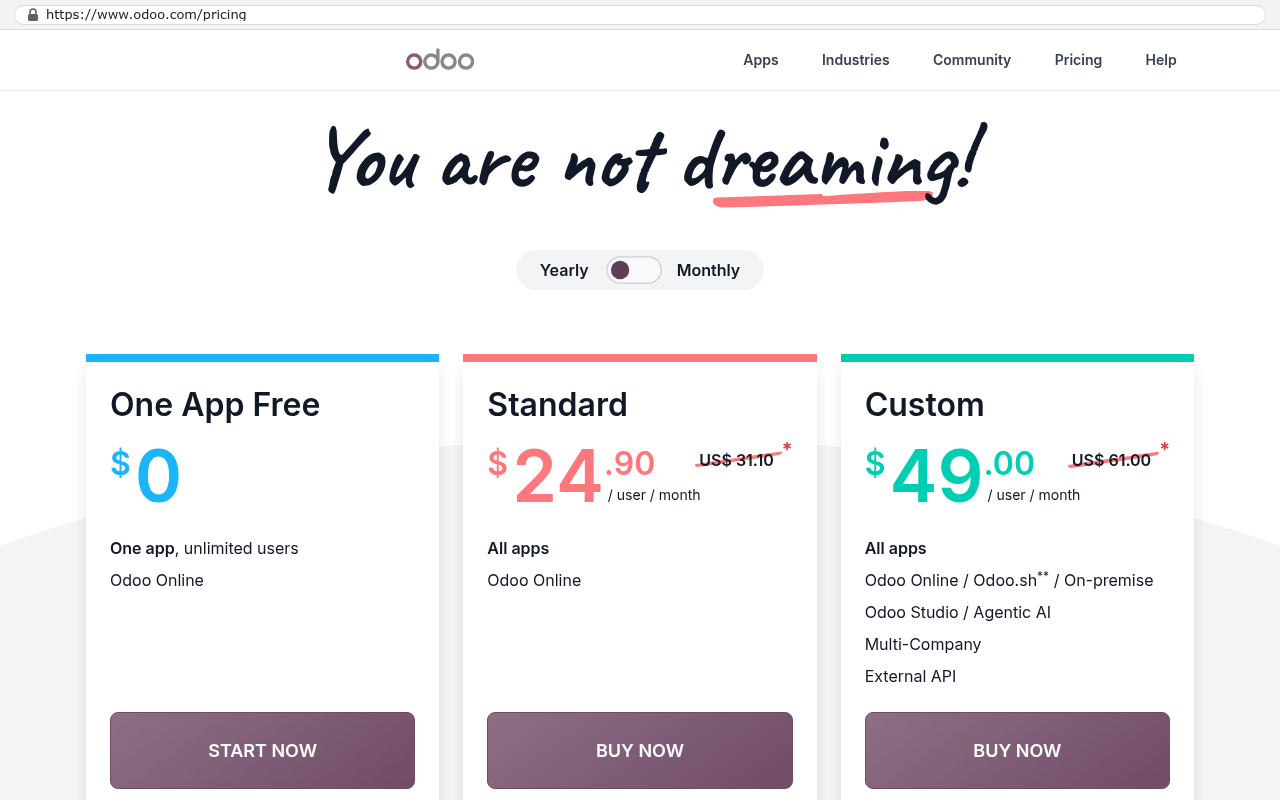
Most companies leaving Acumatica look at three packaged products and one owned option. The table shows what each suits and what to watch, from vendor pages and customer reports. Get at least two quotes for NetSuite, which publishes no price list. Business Central and Odoo publish per-user prices on their Microsoft pricing page and Odoo pricing page.
| Option | Suits | What to watch |
|---|---|---|
| Oracle NetSuite | A growing company that wants one cloud system across finance, inventory and order management and can budget for a quoted subscription plus an implementation | No published price list. Each module, extra subsidiary and sandbox carries its own fee. Customers report renewal increases of 40% to 150%, and two releases a year mean retesting your own scripts. |
| Microsoft Dynamics 365 Business Central | A company already on Microsoft tools that wants a published per-user price for a cloud ERP | Manufacturing puts every full user on the Premium plan. List prices rose at renewal from November 2025. Customers report twice-yearly updates dropping custom extensions until fixed. Bought through a Microsoft reseller. |
| Odoo | A company that wants a published per-user price, a wide set of apps under one fee and a choice of hosting | Studio, the API and multi-company need the Custom plan, about double Standard. Only the last three versions are supported, and from April 2026 renewals cost 25% more on an older one. Implementation and custom code upkeep are extra. |
| Custom cloud system you own | A company whose processes the packaged products do not fit, with many users and someone inside who will own the system | A build cost, hosting and yearly maintenance. You depend on the builder in place of a reseller, and staff still have a new system to learn. |
A move from Acumatica to NetSuite or Business Central trades usage-based pricing for per-user pricing, so model your headcount over the next five years before comparing quotes. The math of per-seat pricing as a team grows and NetSuite vs Odoo vs a custom system cover that comparison in more detail.
What leaving Acumatica involves in practice
Getting the data out. Acumatica says customers own their data in SQL format, so the main exit cost is setting up the new system, not extraction. One limit still applies. API users, concurrent requests and requests per minute scale with your license tier, so a bulk extract through the API can be throttled. Decide early which history moves into the new system and which goes to a read-only archive. See how to migrate ten years of data out of a SaaS platform and what happens to your data when you stop paying a SaaS vendor.
The contract and renewal notice. Read the subscription agreement for the renewal date and the notice period before anything else, and do not let the term roll over while the move is under way. Customers report that the 10% renewal cap lapses if you cut users, edition or tier, so shrinking the subscription ahead of an exit can remove the cap at the next renewal. Negotiate a short final term in writing. How to negotiate a SaaS renewal when you already know you are leaving covers the tactics.
Running both systems side by side. Keep Acumatica live while the new system takes over one process at a time. Keep the general ledger in one place during the overlap and reconcile the two systems at each month-end. Running a custom system in parallel with your current platform sets out how to do this without breaking operations.
The order of moves.
- Price the next Acumatica term under the terms you will have, and set the exit date against the renewal date.
- List every customization, integration and report, since each needs a home in the new system or a decision to drop it.
- Choose the destination and agree the data scope, meaning which records and how many years of history move.
- Build or configure the new system, then test it with a copy of your own data.
- Give notice by the date the contract sets, timed so the subscription ends after cutover.
- Run both systems through at least one month-end close, then cut over and archive the history you did not move.
The custom cloud route
Black Badger builds custom cloud systems that replace cloud ERPs. We replace cloud ERPs only. When a company runs an on-premise system, we replace it only by moving it to the cloud, and we install nothing on site.
The client owns the code and every account it runs on, including hosting and the database. There is no per-seat fee, so adding warehouse staff, field crews or approvers does not change the bill the way a seat license does. Who owns the code when you hire a software company explains what that ownership should look like in a contract.
We have built ERPs of our own, for construction and for manufacturing. A company weighing a move can ask to see them working on our ERPs page.
A custom system does not have to replace everything at once. A company can keep a packaged ledger for consolidation and audit while operations such as orders, inventory, production and field work move to the system it owns. Auditors keep working from a ledger they know, and the operational move happens one process at a time.
A custom system carries its own costs. The company pays for the build, for hosting and for ongoing maintenance, and it depends on the builder in place of a reseller. What to budget for after the build covers the running costs to plan for.
Next step
Start with the Acumatica page for companies weighing a move off Acumatica. Then look at our ERPs to see what an owned system looks like in use. Run your own figures through the payback calculator, and if the numbers point to a move, contact us to talk it through.
Frequently asked questions
Why did my Acumatica price go up when our user count did not change?
Acumatica prices by the applications you use, expected usage and deployment option, not by user seats. Customers report that price-list imports and EDI updates count as transactions, so routine work can move a company into a higher tier without any new users.
Does Acumatica cap renewal increases?
Acumatica caps renewal increases at 10%, according to pricing analysts. Customers report that the cap ignores first-term discounts and lapses if you reduce users, edition or tier, and that one peak month can force a tier upgrade mid-contract.
What happens to the Acumatica Classic UI?
Acumatica deprecates the Classic UI in 2026 R2, and screens that exist only in Classic go away in 2027 R1. Customers report timeouts and lag in the Modern UI, and support told at least one customer to return to Classic while the issue was investigated.
Can I get my data out of Acumatica?
Acumatica says customers own their data in SQL format, so the main exit cost is setting up the new system, not extraction. API users, concurrent requests and requests per minute are limited by license tier, so plan bulk extracts ahead and decide early which history moves and which goes to an archive.
What do companies move to from Acumatica?
NetSuite, Microsoft Dynamics 365 Business Central and Odoo are the usual packaged choices. A custom cloud system the company owns is another option when its processes do not fit a packaged product and someone inside will own the system.
Is Acumatica being sold?
Acumatica agreed in May 2025 to be acquired by Vista Equity, at about $2 billion according to Bloomberg. No customer evidence yet ties the new owner to price increases.
Share this article
Keep reading
How Much Does Custom Software Cost in 2026? Market Ranges by Project Type
Published 2026 market ranges for internal tools, client portals, CRMs, ERP replacements, AI apps and integrations, the seven things that move the price, and hourly rates by region.
If this is your situation
Talk it through on a call
Thirty minutes over video with the person who would run the build. You talk, we ask questions, and you leave with a plain read on whether custom software makes sense for you. If the answer is that your current tool is fine and badly configured, you will hear that.
Who wrote this

David Verneuille
Founder, Black Badger Software Solutions
David Verneuille founded Black Badger after 18 years as a project manager and years implementing Smartsheet, monday.com, Wrike and Zoho for clients. He now builds custom systems that clients own outright, which is why the writing here is specific about where each platform fits and where it stops fitting.