
At list price, Zoho One for 100 employees runs $44,400 a year on the All Employee plan billed annually. Add support tiers, storage and email overages, telephony, payroll, implementation help, and the staff time to keep it all running, and the real annual figure lands well above that. Over five years you are looking at a quarter of a million dollars or more for software you do not own. Zoho is still excellent value for breadth. It is a poor deal when you only need three of its forty-odd apps and your process keeps bending to fit them.
What is the real cost of a Zoho One subscription at 100 employees?
/ 11 min read
TL;DR
Key takeaways
- List price at 100 employees is $44,400 per year annually billed, or $54,000 if you pay monthly.
- The All Employee rule means you license every employee, not just the ones who log in.
- Paid support is priced as a percentage of your license spend, which means it scales with headcount too.
- Storage, email volume, phone calls, payroll and higher analytics limits sit outside the bundle.
- The biggest unbudgeted cost is internal. Someone becomes "the Zoho person" and it eats a real share of their week.
- For a business using the full suite, Zoho One is hard to beat on price. For a business using a slice of it, the arithmetic turns.
On this page
- The sticker price at 100 employees
- The All Employee rule is the line item nobody budgets for
- What the bundle does not include
- The costs that never appear on an invoice
- The five-year arithmetic
- Where Zoho One is still the right call
- What to do before your next renewal
- Read this next
- Frequently asked questions
Zoho One is genuinely cheap software. That is the honest starting point, and anyone who tells you otherwise is selling something. But the number you budget and the number you spend are rarely the same, and at 100 employees the gap gets big enough to matter.
The sticker price at 100 employees
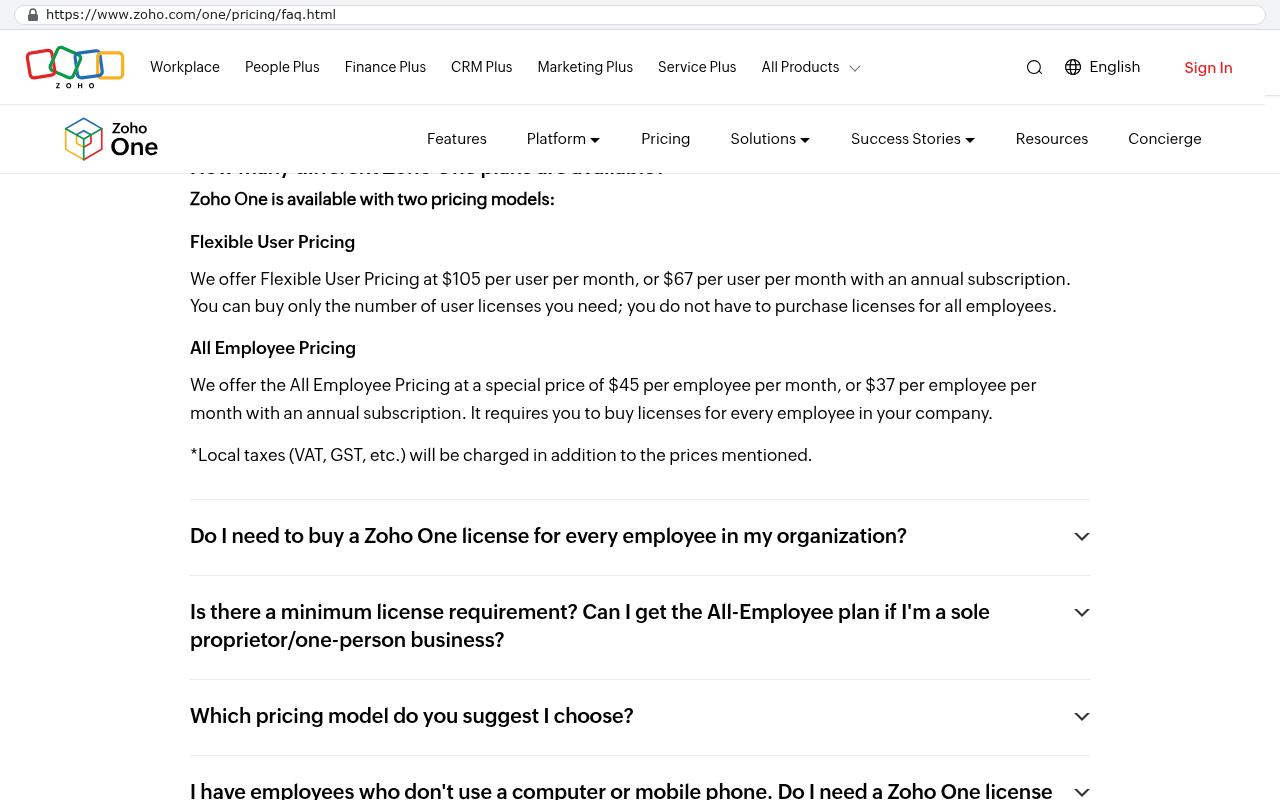
Zoho publishes two prices for Zoho One. The All Employee plan is $37 per employee per month billed annually, or $45 billed monthly. The Flexible User plan is $90 per user per month billed annually, or $105 monthly.
So the math at 100 employees is simple. All Employee, paid annually, is $3,700 a month. That is $44,400 a year. Pay monthly instead and you are at $54,000, which is an $9,600 premium for the privilege of not committing.
For what you get, that is a lot of software per dollar. CRM, helpdesk, accounting, projects, email, chat, HR, expense reports, e-signature, forms, a low-code app builder, and a BI tool. Buying those separately from leading vendors would cost several times more. We implemented Zoho for years and we never argued with the headline value.
The trouble starts when you look at who is actually logging in.
The All Employee rule is the line item nobody budgets for
To get the $37 rate, you have to license every employee in the company. Not every user. Every employee. Zoho is explicit about this, and they do audit it on renewal.
That matters because most 100-person companies do not have 100 people who need a CRM. A manufacturer with 60 people on the floor, 20 in the office and 20 in sales and service has maybe 45 real users. Under the All Employee rule you still pay for 100.
You can switch to Flexible User pricing and license only the 45. At $90 a month that is $48,600 a year. More than the all-employee price. The crossover sits right around 41 users. Below that, flexible is cheaper. Above it, you are better off licensing the whole company.
Check how your contractors, seasonal staff and part-timers are counted before you renew. Companies get surprised at renewal when a 100-person headcount turns into 130 billable seats because the warehouse uses temps and the definition of "employee" was broader than they assumed.
The practical effect is that Zoho One punishes a specific shape of business. If most of your people never touch a screen at work, you pay for them anyway or you pay double for the ones who do.
What the bundle does not include
Zoho One covers a huge amount. It does not cover everything, and the gaps are the ones that grow with you.
Support is the first one. Basic support comes with the subscription. Faster response times and phone access are paid tiers, and Zoho prices them as a percentage of your license spend, generally in the 20 to 25 percent range. On a $44,400 subscription that is roughly $9,000 to $11,000 a year. Most 100-person companies running their accounting and sales pipeline on a platform end up buying it.
Then there are the metered pieces. Storage is pooled per user and overages are billed. Marketing email beyond the included send allowance is billed. Phone calls through Zoho Voice or a connected provider are billed. Payroll sits outside the bundle entirely and is sold separately. Higher data limits in Zoho Analytics cost more. Extra automation runs in Zoho Flow cost more.
None of these are outrageous on their own. Together, on a 100-person deployment with real email volume and a call center, they commonly add five figures a year.
And then there is getting it working. Zoho One is forty-plus applications with inconsistent depth of integration between them. CRM to Books is solid. Creator to everything else takes real work in Deluge, which is Zoho's own scripting language. Someone has to build that. Either you hire a partner, or you grow the skill internally, and both cost money.
The costs that never appear on an invoice
Ask an operations manager at a 100-person company who runs their Zoho. You will almost always get a name, and that person did not have "administer the business system" in their job description.
That is the cost nobody puts in the renewal spreadsheet. Field changes, permission tweaks, broken workflows after an update, new hire onboarding, report requests, the quarterly cleanup of duplicate records. On a deployment this size it is routinely a quarter to a half of one person's week. Price that at a loaded salary and you have another meaningful line item.
The second invisible cost is process drift. Zoho CRM has opinions about what a deal looks like. Zoho Books has opinions about how invoices get approved. When your actual process does not match, you get one of three outcomes. You change the process. You build a workaround in Creator. Or your team keeps a spreadsheet on the side.
That last one is the expensive one, because it is invisible until something goes wrong.
A quick audit that costs you nothing. Ask each department to list the spreadsheets they maintain outside the system. Every one of those is a process the platform could not absorb, and it is a direct measure of how much of your subscription you are not getting value from.
The five-year arithmetic
Subscriptions get judged one year at a time. That is the wrong window. Nobody replaces their core business system after twelve months.
Take the base case. $44,400 a year in licenses. Call it $9,000 for premium support. Say $6,000 across storage, email, telephony and analytics overages. That is roughly $59,000 a year before anyone touches a keyboard. Over five years, about $295,000, and that assumes headcount stays flat and Zoho never raises prices.
Add implementation in year one and a partner on retainer for changes, and you are past $300,000. At the end of it you own nothing. You own your data, which you can export, but you do not own the workflows, the Creator apps, the Deluge scripts, the report definitions or the integrations. Those live on Zoho's side of the line.
Now compare that against a custom system. A build is paid once, as capital you own, and then it costs hosting and maintenance. Cloud hosting for an internal business system serving 100 people is measured in hundreds of dollars a month, not tens of thousands a year. Maintenance is real but it is a fraction of a per-seat subscription, and critically it does not scale with headcount. Hire 30 more people and the subscription bill goes up by $13,320 a year. The hosting bill barely moves.
That is the shift. AI-assisted development has pulled the build cost of a genuinely custom system down far enough that it competes directly with a five-year subscription. That is why we canceled our platform partnerships. We were recommending renewals we no longer believed were the better deal.
Before any renewal, build a five-year total cost line that includes licenses, support, overages, partner fees and an honest estimate of internal admin hours. Then compare it against owning the thing outright. Most companies have never run that comparison, because the renewal arrives as a single number and gets approved as one.
Where Zoho One is still the right call
A custom build is the wrong answer for plenty of what Zoho One gives you, and pretending otherwise would be dishonest.
You should not build your own accounting ledger. You should not build e-signature, payroll, email hosting or video conferencing. These are commodity functions with regulatory requirements and decades of edge cases baked in. Buy them. Zoho bundles them competently and cheaply.
Zoho One also wins when you genuinely use the breadth. If your 100 people are live in CRM, Desk, Books, Projects, People and Cliq every day, $37 a head is a bargain and no custom build will match that range of function for that money.
It wins when you have no appetite for technical ownership. A custom system needs a vendor relationship or an internal owner. If you want to pay a bill and have someone else worry, a subscription does that.
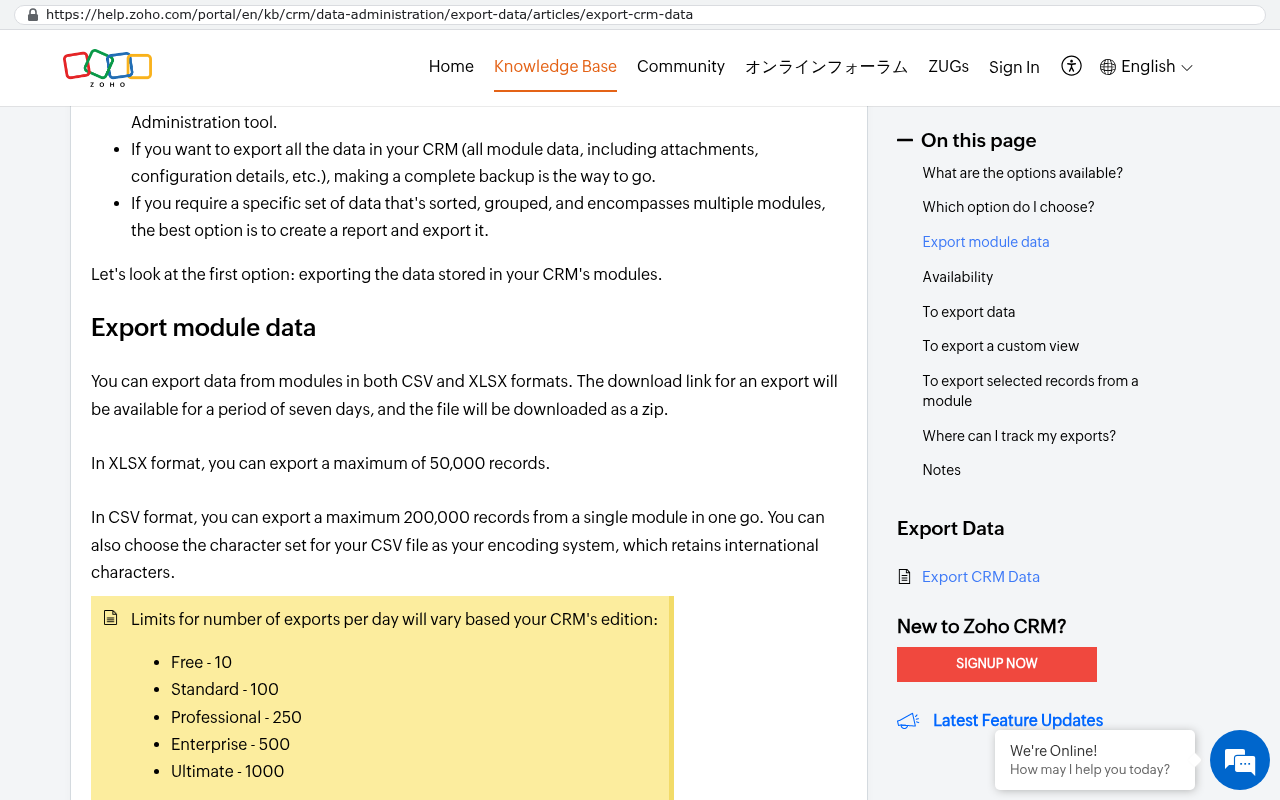
And switching costs are real. Moving off Zoho means exporting data from multiple apps with different export formats, rebuilding automations from scratch, retraining everyone, and running both systems in parallel for a period. Attachments and email history are the painful part. That is a scripted migration, not a copy and paste. Anyone who quotes you a clean switch without scoping that is guessing.
The honest test is coverage. If you use most of the suite, stay. If you are paying for forty apps to use four, and those four keep needing workarounds, the subscription has stopped being the cheap option.
What to do before your next renewal
Start by pulling your actual numbers rather than the list price. Get the real invoice total including every add-on, then count how many of your licensed employees logged in last month. Zoho's admin console will tell you. The gap between seats paid for and seats used is your first finding.
Next, list the processes that live outside the system. Then estimate the hours your internal admin spends on it. Put all of it into a five-year view.
If that number comes back and the suite is earning it, renew with confidence. If it comes back and you are funding forty applications to run four workflows badly, you have a different conversation to have. We will run that comparison with you honestly, including telling you to stay put if staying put is right. You can book a free strategy session and we will go through your actual usage data.
Read this next
If you are weighing a build against a renewal, read our breakdown of when a custom system beats a subscription and how to run that comparison on your own numbers.
- When does a custom system beat a SaaS subscription?
- What actually happens to your data when you leave a platform
- Why per-seat pricing punishes growing companies
Frequently asked questions
What is the annual cost of Zoho One for 100 employees?
At list price with the All Employee plan billed annually, Zoho One costs $44,400 per year for 100 employees, or $37 per employee per month. If you pay monthly instead, the cost rises to $54,000 annually. However, this sticker price does not include support tiers, storage overages, email volume charges, telephony, payroll, and implementation costs, which commonly add significant expenses.
What is the All Employee rule in Zoho One pricing?
The All Employee rule requires you to license every employee in your company, not just those who actually use the system. If you have 100 employees total but only 45 need CRM access, you must still pay for all 100 under the All Employee plan at $37 per month. Alternatively, you can switch to Flexible User pricing at $90 per month and license only active users, though this often costs more at larger headcounts.
What costs are not included in a Zoho One subscription?
Zoho One excludes several important costs. Paid support tiers cost roughly 20 to 25 percent of your license spend. Storage overages, marketing email beyond allowances, phone call charges, and payroll are all billed separately. Zoho Analytics higher data limits and extra Zoho Flow automation also cost more. Implementation through a partner or internal development work adds substantial expense that scales with system complexity.
How much does it cost to get Zoho One implemented?
Implementation costs vary depending on whether you hire a partner or develop skills internally. Zoho One comprises over forty applications with inconsistent integration between them, so building connections using Zoho's scripting language called Deluge requires real work. The text does not specify exact amounts, but notes that implementation help is a line item well above the base subscription price for most deployments.
What is the hidden cost of running Zoho One at 100 employees?
The largest unbudgeted cost is internal staff time. Someone typically becomes the dedicated Zoho person handling field changes, permission adjustments, workflow repairs, onboarding, and record maintenance. This role commonly consumes a quarter to half of one person's week. When priced at loaded salary, this represents a meaningful line item that never appears on an invoice but significantly impacts true total cost.
When is Zoho One a poor deal versus excellent value?
Zoho One is hard to beat on price when you use the full suite across multiple departments and functions. It becomes a poor deal when you only need three or four of its forty-plus applications and must force your actual processes to fit the software's design rather than customize the system to match how you work. The arithmetic favors alternatives when you are paying for breadth you do not actually use.
What happens at renewal if employee headcount changes?
Companies frequently get surprised at renewal when the defined headcount increases beyond expectations. Contractors, seasonal workers, and part-timers may be counted as billable employees depending on how your company defines employee status. A 100-person headcount can become 130 billable seats if warehouse operations rely on temporary staff. You should verify definitions of employee status before renewal to avoid unexpected cost increases.
Share this article
Keep reading
Seat counts as a tax on growth: what per-user pricing does to a hiring plan
Per-user software pricing means every hire raises your subscription bill. Here's how to run the real five-year math, and when owning the system beats renewing.
If this is your situation
Talk it through on a call
Thirty minutes over video with the person who would run the build. You talk, we ask questions, and you leave with a plain read on whether custom software makes sense for you. If the answer is that your current tool is fine and badly configured, you will hear that.
Who wrote this

David Verneuille
Founder, Black Badger Software Solutions
David Verneuille founded Black Badger after 18 years as a project manager and years implementing Smartsheet, monday.com, Wrike and Zoho for clients. He now builds custom systems that clients own outright, which is why the writing here is specific about where each platform fits and where it stops fitting.
Drafted with AI assistance, then checked, edited, and approved by a person before publishing. The facts, opinions, and recommendations are ours.